
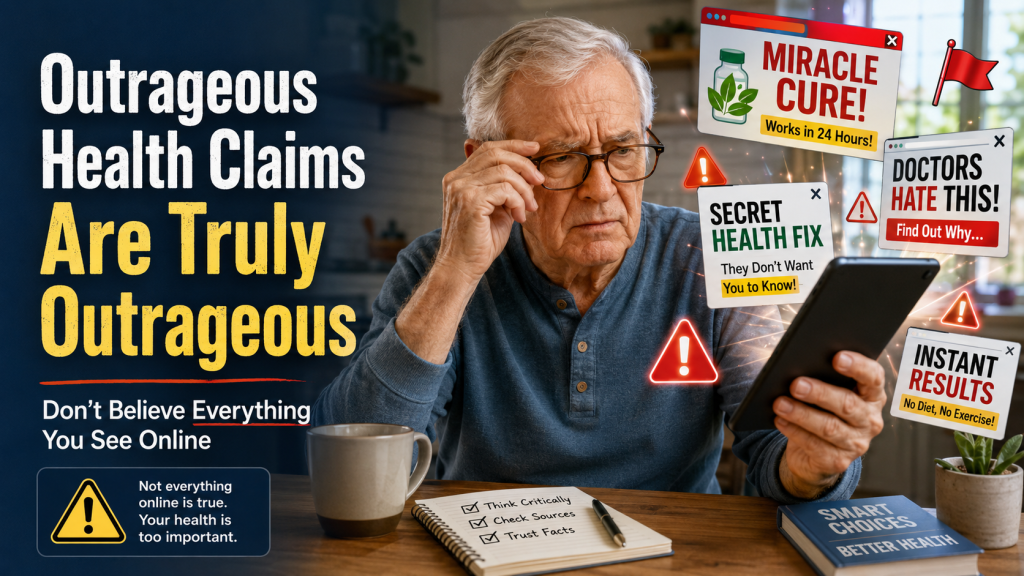
Every day, another video shows up promising something unbelievable.
“Diabetes disappears overnight.”
“Parasites are hiding in your liver.”
“Doctors don’t want you to know this.”
“Big companies are trying to take this down.”
And of course, there is always some bottle, powder, secret tea, mystery supplement, or strange gadget waiting at the end of the video.
Let’s say it plainly: outrageous health claims are truly outrageous.
That does not mean every new idea is false. Medical science is moving fast. New drugs, new research, new tests, and new treatments are coming out all the time. Some of them are exciting. Some may change lives.
But there is a big difference between real medical progress and a stranger online yelling, “Buy this before they ban it!”
One is science. The other is usually sales with a stethoscope costume.
The Internet Has Become the New Medicine Show
Years ago, people had traveling salesmen selling miracle tonics from the back of a wagon. Today, the wagon has Wi-Fi.
The pitch is the same.
They create fear. They promise a secret. They claim the experts are lying. Then they offer a product that supposedly fixes everything.
The U.S. Food and Drug Administration warns that health fraud products often claim to prevent, treat, or cure disease without being proven safe and effective. The FDA also warns that these scams can waste money, delay real diagnosis and treatment, and even cause serious harm.
That is the part people need to understand. A false health claim is not just annoying. It can be dangerous.
If someone has diabetes, heart disease, cancer, memory problems, arthritis, kidney disease, or liver problems, delaying proper care can make things worse. A video may disappear tomorrow. Your health consequences may not.
The Favorite Trick: “They Don’t Want You to Know”
One of the biggest warning signs is the phrase:
“They don’t want you to know this.”
Who is “they”? Doctors? Hospitals? Drug companies? The government? Your neighbor’s cat?
It is always vague. That is the trick.
The claim makes you feel like you are getting secret information. It also makes you suspicious of anyone who disagrees. So if your doctor says, “There is no good evidence for that,” the video has already trained you to think, “Of course you would say that.”
That is not education. That is manipulation.
Real science does not need to whisper in a dark alley. Real science gets tested, challenged, reviewed, repeated, criticized, and improved.
And yes, science can be slow. Doctors can be wrong. Drug companies can put profit first. Regulators can miss things. Nobody should be naïve.
But the answer to imperfect systems is not to trust a guy selling liver parasite drops on Facebook.
“Natural” Does Not Always Mean Safe
Another common trick is the word “natural.”
Natural sounds comforting. Fresh apples are natural. Walking is natural. Sunshine is natural.
But poison ivy is natural too.
The Federal Trade Commission says companies making health claims must have solid proof, especially for products such as supplements, foods, over-the-counter drugs, and other health-related products.
That matters because many online products live in the gray zone. They are advertised like medicine but sold like supplements. They use emotional language, personal stories, and dramatic before-and-after claims.
A supplement may help in some situations. Some nutrients are important. Some people really do need vitamin D, B12, magnesium, fiber, or other support. But that is very different from claiming one capsule can reverse a major disease.
Seniors especially need to be careful because many people are already taking prescriptions. Supplements can interact with medications. Some can affect blood pressure, blood sugar, bleeding risk, liver function, or kidney function.
“Natural” is not a free pass.
The Parasite Panic
One of the most outrageous claims floating around online is that parasites are the hidden cause of almost everything.
Diabetes? Parasites.
Fatigue? Parasites.
Bloating? Parasites.
Memory problems? Parasites.
Liver issues? Parasites.
Now, are parasites real? Yes. Parasite infections exist. Doctors diagnose and treat them.
But the idea that every common chronic condition is caused by parasites hiding in your organs is a giant leap over the Grand Canyon.
If someone truly has a parasite infection, they need proper testing and medical treatment, not a mystery cleanse ordered from a video link.
The online parasite pitch usually follows a pattern. First, it scares you. Then it disgusts you. Then it tells you doctors are ignoring the “real cause.” Finally, it sells you a cleanse.
That is not health education. That is a fear funnel.
Personal Stories Are Not Proof
Many misleading videos include a personal story:
“My aunt took this and her blood sugar was normal in three days.”
“My neighbor used this and avoided surgery.”
“I was tired for years until I discovered this ancient secret.”
Personal stories can be sincere. Some may even be true. But they do not prove cause and effect.
People improve for many reasons. They may have changed their diet, lost weight, started walking, slept better, reduced alcohol, took prescribed medication, or simply had a temporary change in symptoms.
Anecdotes are not the same as evidence.
The National Center for Complementary and Integrative Health warns that health misinformation often includes anecdotes disguised as evidence and excessive claims about “miracle cures.”
That is a very important point. A powerful story can feel more convincing than a boring study. But your body does not care how dramatic the story is. Your body cares whether the claim is true.
The Cancer Cure Problem
This gets especially serious with cancer.
Some online claims suggest that cancer can be cured with special diets, herbs, alkaline water, oxygen drops, cleanses, or other alternative approaches.
The National Center for Complementary and Integrative Health states that no complementary health approach has been shown to prevent or cure cancer. Some approaches may help with symptoms or treatment side effects, but they are not replacements for proven cancer care.
That distinction matters.
Yoga may help stress. Meditation may help anxiety. Nutrition may help strength. Acupuncture may help certain symptoms for some people.
But using those things as support is not the same as rejecting surgery, chemotherapy, radiation, immunotherapy, or other medically recommended treatment.
When someone online tells a cancer patient to ignore their doctor and buy a miracle cure, that is not brave. That is reckless.
Why Seniors Are Often Targeted
Seniors are prime targets for outrageous health claims for several reasons.
First, many older adults are dealing with real health concerns. Pain, fatigue, memory worries, weight gain, diabetes, arthritis, hearing loss, sleep problems, and medication side effects are common.
Second, many seniors feel rushed during doctor visits. They may not always get enough time to ask questions.
Third, the internet offers endless answers. Some are helpful. Some are garbage wearing a lab coat.
Fourth, fear is powerful. If a video says, “This one symptom means your liver is full of toxins,” people may panic.
And finally, seniors have money. Scammers know that. Some online health marketers are not trying to help older adults. They are trying to empty their wallets one bottle at a time.
That may sound harsh, but let’s not pretend everyone online is there out of kindness.
Red Flags That Should Make You Stop
When you see a health claim online, slow down. Do not click “buy” just because the video scared you.
Watch for these red flags:
A product claims to cure many unrelated diseases.
The seller says doctors are hiding the truth.
The ad says supplies are limited or the video may be taken down.
The proof is mostly testimonials.
The claim sounds too easy, too fast, or too good.
The person selling the product also happens to be the only one with the “solution.”
The product says it works for everyone.
There is no clear medical source, no real study, and no explanation of risks.
That last one is important. Real medicine talks about risks. Fake medicine usually talks only about miracles.
Ask the Boring Questions
Before believing a claim, ask boring questions. Boring questions save money. Sometimes they save lives.
Who is making the claim?
Are they selling something?
Is this backed by human studies?
Was the study large enough to matter?
Was it done in people like me?
Was it published in a respected medical journal?
Do major medical organizations agree?
What are the risks?
Could this interfere with my medications?
What does my doctor or pharmacist say?
That may not sound exciting, but neither is falling for a $79 bottle of nonsense.
Real Health Usually Looks Boring
Here is the funny thing. Many of the most helpful health habits are not dramatic.
Walking after meals.
Eating enough protein.
Getting fiber.
Drinking water.
Sleeping consistently.
Keeping blood pressure controlled.
Taking prescribed medications correctly.
Getting recommended vaccines.
Managing blood sugar.
Building muscle.
Staying socially connected.
Not smoking.
Limiting alcohol.
These things do not sound like a secret discovered in an ancient cave. They sound like common sense because they are.
But common sense does not sell as well as “This hidden fruit reverses aging overnight.”
Real health is usually less like fireworks and more like brushing your teeth. Do it regularly, and over time it matters.
Good Skepticism Is Not the Same as Closed-Mindedness
Being skeptical does not mean rejecting everything new.
That would be foolish too.
Many things that are normal today once sounded futuristic. Weight-loss drugs, robotic surgery, gene therapy, cancer immunotherapy, advanced heart procedures, continuous glucose monitors, and artificial intelligence in medicine all seemed remarkable at one time.
So yes, keep your mind open.
But keep the screen door closed so the flies do not come in.
A good attitude is this: interested, but not gullible.
When new research appears, ask: Is this early? Was it done in mice? Was it done in a small group? Is it approved? Is it available? Is it safe? Is it affordable? Does it apply to seniors?
That is how grown-ups handle health information.
Talk to Your Doctor, But Also Prepare
Some people say, “Just ask your doctor.”
That is good advice, but it is not always enough. Many doctor visits are short. Some doctors may not know every supplement or viral claim floating around online.
So go prepared.
Take a screenshot. Write down the name of the product. Bring the ingredient list. Ask your pharmacist about interactions. Look it up on reliable sources like the FDA, FTC, CDC, NIH, or major medical centers.
The CDC has resources focused on helping older adults find, evaluate, and use online health information.
That is exactly the skill seniors need today. Not fear. Not blind trust. Skill.
The Elderhood Rule: Pause Before You Believe
Here is a simple rule:
If a health claim makes you scared, excited, angry, or rushed, pause.
That emotional reaction may be exactly what the seller wanted.
Do not buy while scared. Do not share while angry. Do not stop medication because of a video. Do not start a supplement without checking whether it is safe for you.
Your health is not a slot machine. Do not pull the lever because someone online promised a jackpot.
Better Information, Better Choices
At Elderhood, the goal is not to mock people for believing things. Good people fall for bad information every day.
The goal is to protect people.
Seniors deserve clear, honest, practical health information. Not hype. Not panic. Not miracle cures. Not “move fast before they delete this.”
You have worked too hard, lived too long, and learned too much to hand your health decisions over to a stranger with a dramatic video and a shopping cart link.
Be curious. Be hopeful. Be open to real progress.
But when the claim is outrageous, treat it like an expired carton of milk.
Look at it.
Smell it.
Then throw it out.
Final Takeaway
Outrageous health claims are truly outrageous because they do more than spread bad information. They create fear, waste money, delay proper care, and can put people in danger.
The next time you see a video claiming one secret cure fixes everything, remember this:
Real health information does not need scare tactics.
Real science does not hide behind “they don’t want you to know.”
And real wisdom means knowing when to say, “That sounds interesting — but I’m checking before I believe it.”
Share this with a friend, a spouse, an adult child, or anyone who keeps sending you miracle cure videos at 11 o’clock at night.
Sometimes the healthiest thing you can do is not buy the bottle.