
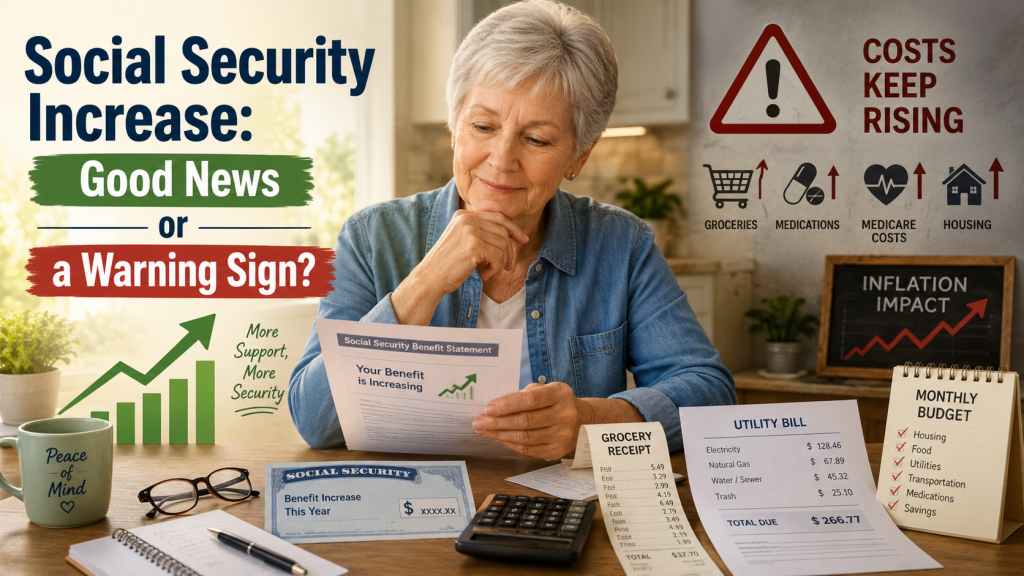
Every time Social Security announces an increase, the headlines make it sound like seniors just won the lottery.
“Benefits are going up!”
That sounds wonderful — until you go to the grocery store, open your electric bill, pick up a prescription, or see what Medicare Part B is taking out of your check.
Then reality taps you on the shoulder and says, “Don’t spend that raise yet.”
For 2026, Social Security benefits increased by 2.8%, according to the Social Security Administration. That adjustment is called the COLA, which stands for Cost-of-Living Adjustment. It is designed to help Social Security benefits keep up with inflation. Nearly 71 million Social Security beneficiaries are affected by the increase.
So yes, a Social Security increase is good news.
But it can also be a warning sign.
Because if your check goes up, but your real-life expenses go up faster, you are not actually getting ahead. You are just trying not to fall behind.
That is the part many people miss.
What Is the Social Security COLA?
The Social Security COLA is an annual adjustment meant to help benefits keep up with inflation. It is based on changes in a government inflation measure called the Consumer Price Index for Urban Wage Earners and Clerical Workers, often shortened to CPI-W.
That sounds like something only an economist could love.
But the basic idea is simple: if prices rise, Social Security checks are supposed to rise too.
The problem is that many seniors do not spend money like younger workers do. Older adults often spend more of their income on health care, housing, insurance, prescriptions, utilities, and food. Those are not optional expenses. Nobody says, “I think I’ll skip electricity this month and treat myself to darkness.”
That is why a COLA can look decent on paper but feel disappointing in real life.
A 2.8% increase may help, but it may not fully cover the actual cost increases many retirees face.
Why the Increase Feels Smaller Than It Sounds
Let’s say someone receives around $2,000 a month from Social Security. A 2.8% increase would add about $56 a month before deductions.
Now that sounds nice.
But then Medicare Part B enters the room.
The standard Medicare Part B premium rose to $202.90 per month in 2026, up from $185.00 in 2025, according to the Centers for Medicare & Medicaid Services. That is an increase of $17.90 per month. The Part B deductible also rose to $283 in 2026, up from $257 in 2025.
So if your Social Security increase is about $56 per month, and Medicare Part B takes $17.90 of that, a chunk of the raise is gone before you even see it.
That is why seniors often say, “My Social Security went up, but my check barely changed.”
They are not imagining it.
The increase is real. But so are the deductions.
For many people, the raise is like getting a bigger umbrella during a rainstorm — helpful, but you are still getting wet.
The Grocery Store Test
The best way to understand whether a Social Security increase is good news is not to look at the headline.
Look at your grocery receipt.
Food is one of the most painful areas for seniors because it hits every week. A little increase in eggs, yogurt, fish, vegetables, coffee, or frozen fruit adds up quickly.
And here is the frustrating part: seniors are often told to eat healthier as they age. That is good advice. But healthy food can feel expensive if you do not shop carefully.
This is why planning matters.
A Social Security increase should not be treated like “extra money.” For many retirees, it is protection money against inflation.
That does not mean seniors should live in fear. It means they should live with their eyes open.
One smart move is to use the increase to strengthen the basics: better food, fewer processed snacks, affordable protein, frozen fruits and vegetables, and pantry items that do not spoil quickly.
For more on this kind of practical aging strategy, you may want to read Healthy Aging Starts With the Small Choices You Make Every Day. The big picture is simple: small choices repeated daily often matter more than dramatic resolutions.
Medicare Can Eat the Raise
For retirees, Medicare is one of the biggest reasons the Social Security increase may not feel like much.
Most people have their Medicare Part B premium deducted directly from their Social Security check. That means when Part B rises, your net Social Security deposit may not rise as much as the COLA headline suggests.
This is not a small issue.
Health care costs have a way of showing up at the worst possible time. Premiums, deductibles, copays, prescriptions, dental care, eyeglasses, hearing aids, and over-the-counter items can all put pressure on a fixed income.
Original Medicare does not cover everything. Medicare Advantage plans may include extra benefits like dental, vision, hearing, gym memberships, and over-the-counter allowances, but the details vary by plan and county. Medicare Supplement plans can help with certain out-of-pocket medical costs, but they usually come with higher monthly premiums.
That is why retirees should review their Medicare coverage every year, especially during the Annual Enrollment Period.
A Social Security increase is good. But choosing the wrong Medicare plan can wipe out that increase quickly.
For Medicare education and private plan comparison, you can visit MedicareSelfEnroll.com. The point is not to rush. The point is to compare your options before making a decision.
The Warning Sign: Inflation Has Not Disappeared
A Social Security increase is not a gift from Washington.
It is a response to inflation.
That is the warning sign.
If benefits are going up, it usually means prices have already gone up. Social Security is trying to catch up to what already happened.
That is like getting a weather report after your basement flooded.
The COLA helps, but it is backward-looking. It does not guarantee that next year’s rent, insurance, food, electricity, or medical costs will stay calm.
This is especially important for seniors who rely mostly or entirely on Social Security. If Social Security is your main income source, even small price increases can hurt.
A $20 increase in utilities, a $15 increase in medication, a $10 increase in groceries, and a higher Medicare premium can quietly swallow the entire COLA.
That is not being negative. That is arithmetic.
And arithmetic does not care how nice the headline sounds.
Social Security’s Long-Term Problem
There is another warning sign: the long-term financial pressure on Social Security itself.
The 2026 Social Security Trustees Report said the combined Old-Age and Survivors Insurance and Disability Insurance trust fund reserves declined by $160 billion in 2025, falling to $2.56 trillion. The report also said annual program costs are projected to exceed annual income in 2026 and remain higher throughout the 75-year projection period.
The Trustees also report that the Old-Age and Survivors Insurance trust fund is projected to face depletion in the early 2030s if Congress does not act.
Now, this does not mean Social Security disappears.
That is important.
Social Security is funded largely by payroll taxes from current workers. Even if trust fund reserves were depleted, ongoing payroll tax revenue would still come in. But without changes, future benefits could face reductions.
That is why this issue matters.
Seniors should not panic, but they should pay attention. Politicians have avoided serious Social Security reform for years because it is politically dangerous. Nobody wants to be the person who tells retirees the math is ugly.
But the math is ugly.
The longer Congress waits, the harder the fix becomes.
Good News: The Increase Still Helps
Now let’s be fair.
The Social Security increase is still helpful.
For millions of retirees, every dollar matters. An extra $40, $50, or $70 a month can help pay for groceries, gas, prescriptions, or utilities.
It may allow someone to buy better food, replace worn-out shoes, pay a copay, or keep the thermostat at a safer temperature.
So no, we should not dismiss the increase.
But we should not over-celebrate it either.
It is not a raise in the normal sense. It is more like a partial refund for higher prices you already paid.
That is why the smarter question is not, “How much did Social Security go up?”
The smarter question is, “How much of that increase do I actually get to keep?”
What Seniors Should Do With the Increase
The worst thing seniors can do is assume the increase means they can relax financially.
Instead, treat it as a signal to review your household budget.
Start with the basics.
Look at your Medicare premium. Look at your prescriptions. Look at your grocery bill. Look at your utility bills. Look at insurance. Look at subscriptions. Many people have small automatic charges they forgot about. Those little charges are like financial termites. One does not look dangerous. Ten of them can chew through your budget.
Next, look at food spending.
This is where many seniors can protect both their health and their wallet. Frozen vegetables, frozen berries, eggs, Greek yogurt, cottage cheese, beans, oatmeal, sardines, canned salmon, and store-brand staples can be powerful tools.
You do not have to be wealthy to be healthy in old age.
That line matters because too many people assume healthy aging requires expensive programs, exotic supplements, or fancy meals. It does not.
Often, it requires simple habits repeated consistently.
For more healthy aging ideas, visit Elderhood.info, where the focus is practical aging, not fantasy aging. Nobody needs a $19 smoothie with a name like “Ancient Moon Glow” to get through retirement.
Watch Medicare Advantage and Part D Changes
Another smart move is to review your Medicare plan every year.
Do not assume your plan will stay the same.
Medicare Advantage benefits can change. Drug formularies can change. Copays can change. Doctor networks can change. Pharmacies can move in or out of preferred status.
Part D drug plans can also change. A medication that was affordable one year may become more expensive the next year.
This is where many retirees get surprised.
They focus on the Social Security increase but ignore the Medicare changes that may cost them more than the increase gives them.
That is like celebrating a $50 raise while someone is quietly removing $75 from your coat pocket.
The Annual Notice of Change is not junk mail. It is one of the most important Medicare documents you receive each year.
Read it. Compare it. Ask questions.
If you want to review Medicare options privately, you can use MedicareSelfEnroll.com. No pressure. No kitchen-table ambush. Just options.
The Bigger Lesson: Income Is Only Half the Story
A Social Security increase is about income.
But retirement security is also about spending, health, habits, and choices.
If your income rises by 2.8%, but your spending rises by 6%, you are losing ground.
If your benefit rises, but you are eating more ultra-processed food because it feels convenient, your health may suffer later.
If your check goes up, but your Medicare plan no longer fits your doctors or prescriptions, you may face bigger costs.
That is why the Social Security increase should be treated as a reminder.
Review your budget.
Review your Medicare.
Review your food choices.
Review your health habits.
Review what you can control.
Because the government may adjust your check once a year, but you make choices every day.
Final Takeaway
So, is the Social Security increase good news or a warning sign?
It is both.
It is good news because seniors need every dollar they can get. The increase helps. It matters.
But it is also a warning sign because the cost of aging is rising. Medicare premiums are rising. Food costs are still painful. Health care remains expensive. And Social Security itself faces long-term financial pressure unless Congress acts.
The answer is not panic.
The answer is preparation.
Do not look at the Social Security increase as extra spending money. Look at it as a chance to strengthen your foundation.
Use it wisely. Compare your Medicare options. Watch your food budget. Protect your health. Build simple habits. Ask questions before making decisions.
Because in retirement, the goal is not just to get a bigger check.
The goal is to make that check work harder for you.
And remember: a raise is nice, but keeping your common sense is priceless.