
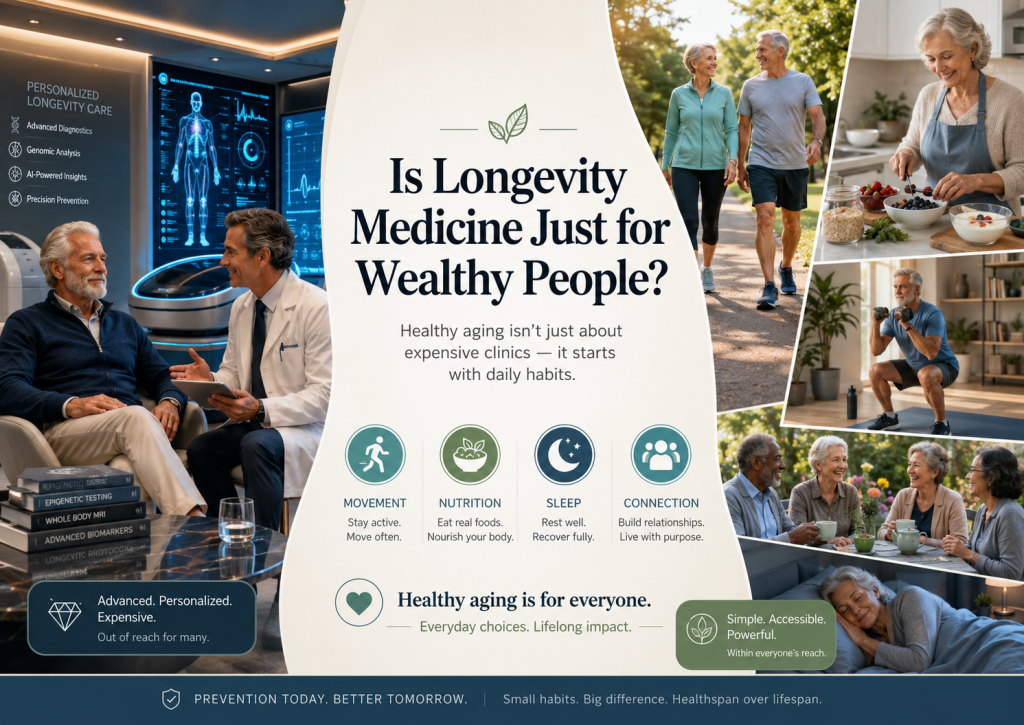
Longevity medicine sounds expensive.
The minute you hear the phrase, you may picture a billionaire walking into a marble clinic, getting a full-body scan, a genetic test, a private chef, a custom supplement plan, and maybe a doctor who looks like he was grown in a lab himself.
And yes, some of that world exists.
There are expensive longevity clinics. There are advanced tests. There are people paying thousands of dollars to measure every molecule in their body. Some of it may be useful. Some of it may be early science. And some of it may be a very expensive way to be told what your grandmother already knew: eat better, move more, sleep well, and stop doing foolish things to your body.
So the honest answer is this:
Longevity medicine is not just for wealthy people — but the luxury version of longevity medicine often is.
The good news is that many of the most powerful steps for healthy aging are not locked behind a velvet rope. You do not need a private clinic, a celebrity doctor, or a refrigerator full of mystery powders to begin improving your odds.
You need knowledge, consistency, and the willingness to make better daily choices.
That is what Elderhood is about: practical healthy aging without pretending every senior has a private chef and a wallet the size of a sofa cushion.
What Is Longevity Medicine?
Longevity medicine is a growing field focused on helping people live longer, healthier lives.
But the key word is not just longer.
The real goal is healthspan — the number of years you live with strength, independence, clear thinking, and quality of life.
Living longer is not very appealing if those extra years are spent weak, isolated, confused, or dependent on everyone around you. Most people do not just want more birthdays. They want more good years.
That is where the conversation changes.
Longevity is not only about reaching age 95. It is about reaching later life with enough energy to walk, think, laugh, visit family, make decisions, and still enjoy being alive.
That kind of longevity is not reserved only for rich people.
The Expensive Side of Longevity
Let’s be fair. Some advanced longevity tools are expensive.
These may include:
Genetic testing
Biological age testing
Full-body MRI scans
Advanced blood panels
Continuous glucose monitors
Personalized supplement programs
Private medical coaching
Regenerative medicine procedures
Concierge medicine memberships
Some of these tools may become more useful over time. Some may help doctors detect problems earlier. Some may help motivated people better understand their risks.
But here is the problem: expensive testing can make people believe that healthy aging is mostly about technology.
It is not.
Technology may help measure your health. But measurement is not the same as improvement.
A bathroom scale can tell you that you gained weight. It does not walk around the block for you.
A blood test can show your blood sugar is high. It does not remove the cookies from the pantry.
A sleep tracker can tell you that you slept badly. It does not shut off the television at midnight.
That is the part we have to remember. Data can be useful, but daily behavior still matters.
The Affordable Side of Longevity
The affordable side of longevity medicine is where most people should begin.
The National Institute on Aging says healthy aging is supported by staying physically active, making healthy food choices, getting enough sleep, limiting alcohol, and being proactive with health care.
That is not science fiction. That is daily life.
And the CDC describes healthy aging as maintaining physical, mental, and social well-being as we grow older. It also emphasizes that it is never too late to adopt healthier habits.
That last part matters.
Too many seniors think, “Well, I’m already old, so what difference does it make?”
That is the wrong way to look at it.
At 65, 70, 75, 80, or even older, your body is still responding to what you do. It may not respond as fast as it did when you were 25, but let’s be honest — at 25, many of us were feeding it hot dogs, soda, and confidence.
The body is not done listening.
Food Is Longevity Medicine
One of the most powerful forms of longevity medicine is food.
Not fancy food. Not imported berries blessed by monks on a mountain. Just real food.
Vegetables. Beans. Eggs. Fish. Greek yogurt. Oatmeal. Berries. Olive oil. Nuts. Greens. Whole foods that your body recognizes as food and not as a laboratory project.
A healthy diet does not have to be expensive. In fact, many unhealthy foods are more expensive than people realize.
A bag of potato chips may cost several dollars and contain less than one potato. Soda is not cheap when you consider what it does to your body over time. Ultra-processed snacks may seem convenient, but they are often designed to make you eat more, not nourish you better.
That is why one of the most practical longevity steps is changing your pantry.
If your kitchen is full of foods designed to work against you, willpower has to fight a battle every day. And willpower gets tired. It has bad knees. It wants to sit down.
A better strategy is to make the healthy choice the easy choice.
If you want more on that idea, read this related Elderhood article: Two Low-Calorie Beverages Linked to Healthy Aging.
Movement Is Longevity Medicine
Exercise does not have to mean joining an expensive gym or training like you are preparing for the Olympics.
For seniors, movement is medicine.
Walking is medicine.
Wall push-ups are medicine.
Heel raises are medicine.
Light strength training is medicine.
Balance exercises are medicine.
Getting up after a meal and moving for a few minutes is medicine.
The body was designed to move. When we stop moving, muscles shrink, balance weakens, blood sugar control worsens, and independence can slowly disappear.
That does not mean everyone should do the same exercise. A person with arthritis, back pain, neuropathy, heart disease, or balance problems may need to modify activity. But almost everyone can do something.
The great mistake is thinking exercise has to be dramatic to matter.
It does not.
Small movement done consistently beats heroic movement done once every three months.
You do not need to become a gym warrior. You need to stop parking your body all day like an old Buick in the driveway.
Sleep Is Longevity Medicine
Sleep is often ignored because it is not glamorous.
Nobody brags at a party, “I got seven and a half hours of high-quality sleep last night.”
But maybe they should.
Sleep affects memory, blood pressure, blood sugar, appetite, mood, immune function, and the body’s ability to repair itself.
Poor sleep can make it harder to control weight. It can increase cravings. It can make you more irritable. It can make your brain feel like someone left the lights on but nobody is home.
For older adults, sleep may change with age, but that does not mean poor sleep should be ignored. Sleep apnea, medications, alcohol, late meals, pain, stress, and poor sleep habits can all interfere.
A simple longevity step is to protect your sleep.
Try going to bed and waking up at consistent times. Reduce late-night snacking. Avoid alcohol as a sleep aid. Keep screens out of the final stretch of the evening. Talk to your doctor if you snore heavily, wake up gasping, or feel tired despite spending enough time in bed.
Sleep is not laziness. Sleep is maintenance.
Even a car needs time in the garage.
Social Connection Is Longevity Medicine
This is one of the most overlooked parts of aging.
Longevity is not only about cholesterol, blood pressure, and vegetables. It is also about connection.
Loneliness and isolation can damage health. Human beings are not built to live as abandoned furniture.
Staying connected with family, friends, neighbors, faith communities, clubs, volunteer groups, or local activities can help protect emotional and cognitive health.
A conversation can be medicine.
A walk with a friend can be medicine.
A phone call can be medicine.
Having someone notice when you do not sound right can be medicine.
This is especially important for seniors living alone. You do not need a giant social calendar. You need regular human contact that reminds you that you are still part of the world.
That does not cost thousands of dollars. It may cost the effort of picking up the phone.
Prevention Is Longevity Medicine
One of the most affordable longevity strategies is prevention.
That means staying current with checkups, screenings, vaccines, dental care, eye exams, hearing checks, and medication reviews.
It also means paying attention to small problems before they become big ones.
Too many people ignore symptoms because they do not want to be bothered. That is understandable. Nobody wants one more appointment. But ignoring warning signs does not make them polite enough to leave.
Blood pressure matters.
Blood sugar matters.
Hearing matters.
Vision matters.
Balance matters.
Medication side effects matter.
Numbness, weakness, chest pain, shortness of breath, sudden confusion, or new neurological symptoms should not be brushed aside.
Good longevity medicine is not just about adding exotic treatments. Sometimes it is about catching ordinary problems early.
Do Supplements Count as Longevity Medicine?
Supplements can help when there is a real need.
Vitamin B12, vitamin D, magnesium, protein support, omega-3s, or other supplements may be useful for some people. But supplements should not become a substitute for food, movement, sleep, or medical care.
The supplement industry loves hope. Hope sells bottles.
That does not mean all supplements are bad. It means you should be skeptical.
Ask:
Do I actually need this?
Is there evidence for it?
Could it interact with my medication?
Is the dose appropriate?
Is the company trustworthy?
Have I talked to my doctor or pharmacist?
A supplement should support a healthy lifestyle, not replace one.
You cannot out-supplement a terrible diet. That is like putting premium gas in a car with no tires.
The Rich Person Trap
Here is the danger of the modern longevity industry: it can make regular people feel locked out.
When people see expensive clinics, celebrity doctors, and luxury wellness programs, they may think, “Well, that is not for me.”
And then they do nothing.
That is the tragedy.
Because the most important longevity tools are still available to most people.
You can walk.
You can improve breakfast.
You can eat more protein.
You can reduce soda and ultra-processed snacks.
You can go to bed earlier.
You can build muscle with simple exercises.
You can call a friend.
You can ask your doctor better questions.
You can learn something new.
You can stop treating your body like it came with a lifetime warranty and no maintenance schedule.
The wealthy may have access to more testing, more coaching, and more convenience. But they do not have exclusive ownership of discipline, common sense, or daily habits.
What Money Can Buy — And What It Cannot
Money can buy convenience.
It can buy better access.
It can buy testing.
It can buy personal trainers, chefs, and medical consultants.
That is real.
But money cannot walk for you.
Money cannot sleep for you.
Money cannot make you stop eating junk food at 10 o’clock at night.
Money cannot build meaningful relationships for you.
Money cannot give you purpose.
Money cannot force you to take action.
A wealthy person can still be unhealthy. A modest-income person can still make powerful choices.
The playing field is not perfectly equal. Let’s not pretend it is. But it is also not hopeless.
The Elderhood View of Longevity
At Elderhood, the message is simple:
Healthy aging should not be treated like a luxury product.
It should be treated like common knowledge that everyone deserves.
You should not have to be wealthy to learn how food affects your brain, how movement protects your muscles, how sleep supports repair, how social connection protects your spirit, and how prevention helps you stay independent.
Longevity medicine should not only belong to people who can afford private clinics.
The future of healthy aging should include regular people making smarter choices with the resources they already have.
That is why Elderhood focuses on practical education. You can explore more healthy aging topics at Elderhood.info.
Where to Start
If you want to begin your own version of longevity medicine, start simple.
Do not start with a $5,000 test.
Start with breakfast.
Start with a walk.
Start with going to bed on time.
Start with checking your blood pressure.
Start with adding protein.
Start with replacing soda.
Start with calling someone instead of sitting alone.
Start with asking your doctor, “What should I be doing now to stay independent longer?”
That is real longevity medicine.
Not flashy. Not expensive. Not something you need a billionaire’s bank account to begin.
Just practical steps repeated often enough to matter.
The Bottom Line
Longevity medicine is not just for wealthy people.
The luxury version may be.
The high-tech testing version may be.
The private-clinic version may be.
But the foundation of healthy aging belongs to everyone.
Food. Movement. Sleep. Prevention. Purpose. Connection. Strength. Curiosity. Better daily choices.
Those are not rich people secrets. Those are human basics.
The real question is not whether you can afford longevity medicine.
The real question is whether you are willing to practice the parts of it that are already within reach.
Because healthy aging does not begin in a luxury clinic.
It begins in the ordinary choices you make today.
And the beautiful part is this: ordinary choices, repeated long enough, can become extraordinary results.